
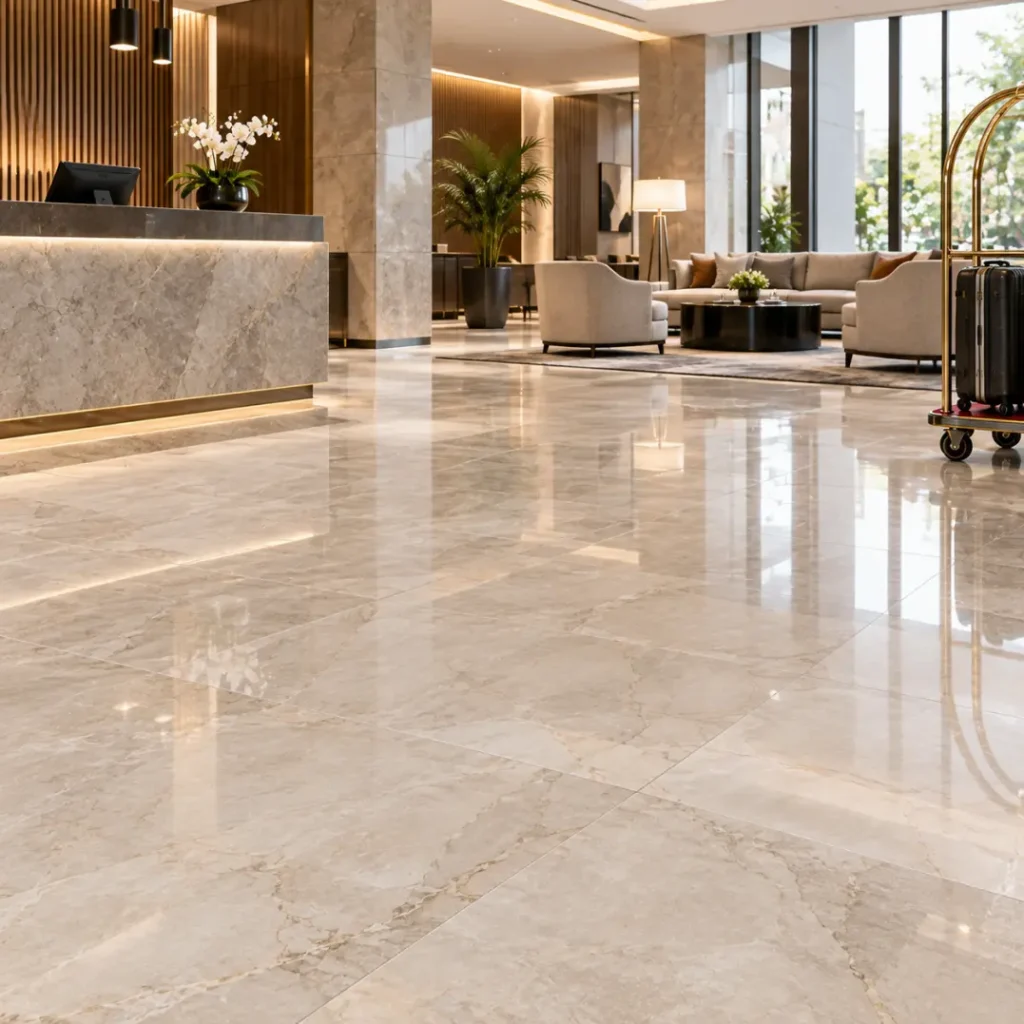
Choosing the best tile for hotels is a big decision. Guests walk on it, roll luggage over it, and judge your property by how it looks. Staff clean it every day, and you live with your choice for years. If you are planning a new build or a renovation, this guide covers what to check before you buy. While you read, you can browse our Premium tiles for hospitality spaces to see what is available.
Why the Right Tile Matters in Hospitality
Hotels are hard on floors. Picture a normal day in a lobby. Guests walk in with wet shoes. Luggage carts roll across the floor. Housekeeping carts travel down the corridors, and restaurant chairs get dragged back and forth. Then it all happens again tomorrow.
A hospitality floor has two jobs. It must look good, because the floor is one of the first things a guest notices. It must also handle commercial use, which means much more foot traffic than a home sees. A floor that looks great but wears out early costs more in the long run, because you pay for repairs, closed areas, and a second installation.
When you choose the best tile for hotels, keep four things in mind: strength, safety, looks, and upkeep. The rest of this guide follows those four.
Is Tile the Best Flooring for a Hotel?
Hotels use many materials, including carpet, hardwood, luxury vinyl, natural stone, and tile. Each has a place. Here is a fair look at them.
- Carpet is soft and quiet, which guests like in bedrooms. It can be harder to keep fresh in busy or wet areas.
- Hardwood looks warm, but it can scratch and does not like standing water.
- Luxury vinyl is popular and easy to install. Depending on quality, the surface may show wear in very heavy use.
- Natural stone, like marble, looks grand. It usually needs sealing and careful cleaning.
- Porcelain tile is dense and handles heavy foot traffic. It can also copy the look of marble, stone, and wood.
For lobbies, corridors, restaurants, and bathrooms, porcelain is often the best flooring choice. Good porcelain absorbs less than 0.5% water, so spills do not soak in. At Rocagres Surfaces, our porcelain is fired at over 1,220°C, which creates a strong, dense tile body.
Many hotels mix materials. They may use tile in public areas and bathrooms, and carpet or wood-look tile in guest rooms. The goal is to match each material to the way the space is used.
Check the Wear Rating First
Before you fall in love with a design, make sure the tiles are durable enough for commercial use. For glazed tile, the PEI wear rating runs from one to five. A higher number means the surface resists wear better. For busy commercial floors, PEI 4 or PEI 5 is the usual range. Choose PEI 5 for the spots with the heaviest traffic, such as main entrances, the lobby, and busy restaurant floors.
Here are a few more points to check:
- Ask for the rating in writing. A good supplier can show you a spec sheet. If a seller cannot show the wear rating, take that as a warning sign.
- Look at the color layer. Color body tiles have color that runs through the tile, so small chips and scuffs are harder to see.
- Check the surface. A dense, low-absorption surface resists stains and is easier to clean.
Check the Slip Resistance of Commercial Tile
Safety is one aspect to consider when choosing a hotel floor, and it may be the most important one. Lobbies get wet on rainy days. Bathrooms, spas, and pool areas are wet every day.
In the US, a common measure is the dynamic coefficient of friction, or DCOF. It tells you how much grip a tile has when the surface is wet. The test method comes from the American National Standards Institute (ANSI), in a standard called ANSI A326.3. For tile that people will walk on while wet, the common benchmark is a DCOF of 0.42 or higher. Checking the dynamic coefficient of friction on a tile’s data sheet takes a few minutes, and it can prevent a serious problem later.
Keep two cautions in mind:
- The number is a starting point, not a promise. Shoes, cleaning products, and floor care all change how a floor feels underfoot.
- Ask for the number for the exact tile and finish you plan to buy. A general claim about a whole collection is not enough.
Slip safety also protects your team. OSHA’s walking-working surfaces rule asks employers to keep work-area floors clean and, as far as possible, dry, and to inspect walking surfaces regularly. The rule does not pick a tile for you. But it is a good reminder that kitchens, laundry rooms, and service corridors need both a smart tile choice and a good cleaning routine.
Choosing the Right Finish for Each Area
The finish changes both the look and the grip of a tile. Here is a simple guide.
- Matt has a low shine. It hides dust, fingerprints, and light scratches, and it usually grips better. For busy and wet floors, matt tiles are a safe place to start.
- Glossy reflects light and makes a space feel bright. It works well on walls. On floors, it can feel slick when wet.
- PGVT (polished) has a mirror-like shine. It suits premium lobbies, but check the DCOF and plan your floor care.
- Carving (textured) adds a 3D look to feature walls.
- Rustic gives a natural, aged feel and fits spaces that need warmth.
A smart and common combination in bathrooms is a matt floor with glossy walls. You get grip underfoot and light on the walls.
Picking the Right Tile for Each Hotel Area
A hotel is not one space. It is many spaces with different needs. The right tile for a business like a hotel is really a set of tiles that suit each area.
Lobby and Reception Area
The lobby sets the tone. Large format tiles are a popular choice because they create fewer grout lines and make the space feel open. Our Evergreen 1200×1800 mm tiles are about 4 by 6 feet, a size often chosen for hotel lobbies and atriums.
If you want a luxury look, marble-look porcelain is worth a close look. Our Statuario and Calacatta marble-look tiles give you the grand look of marble. Natural marble can stain and needs regular sealing, while marble-look porcelain does not.
For the reception area, a small design touch can help guests find the desk. A diamond-pattern layout or a contrasting border can mark the spot without adding clutter.
Corridors
Corridors take constant rolling traffic from luggage and housekeeping carts. Choose PEI 4 or 5, and pick a mid-tone color that hides marks. Long plank tiles in a 200×1200 mm size or a chevron layout can guide guests down the hall and break up a plain stretch.
Guest Rooms
Guest rooms should feel calm and warm. Wood-look porcelain planks give the feel of timber with the strength of tile. Neutral colors such as beige, cream, and soft gray work with most furniture. Tile is hard and can echo, so add rugs or ask about sound-reducing underlayment below the tile.
Bathrooms
Bathrooms need grip and easy cleaning. Use a matt tile on the floor and check its DCOF. Use a glossy or light tile on the walls. Large tiles mean fewer grout lines, which means less to scrub. Porcelain itself absorbs very little water, but tile alone is not a waterproofing system. Showers still need proper waterproofing under the tile.
Restaurants and Cafés
Dining areas need a floor that can take spills, chairs, and heavy use. PEI 4 is the minimum for a busy restaurant, and PEI 5 is better where traffic is heaviest. Terrazzo-look porcelain is a good choice because its pattern helps hide small marks.
Offices and Conference Rooms
Hotels also have back offices, business centers, and conference rooms. Office spaces need a clean, quiet look and a floor that handles rolling chairs. Using the same collection or a matching color family keeps the design consistent with the rest of the property.
Pool Decks and Outdoor Areas
Outdoor areas need tile made for wet weather and strong grip. Look at our outdoor tiles, which are made for patios, pool decks, and walkways. If your hotel is in a cold climate, ask whether the tile suits freezing weather. Low water absorption matters here.
Don’t Forget Installation
Even a great tile can fail if the installation is poor. Installation is where many hotel projects go wrong, so plan for it early.
- Prepare the base. The floor under the tile should be flat and clean. Large tiles show every dip.
- Hire skilled installers. Large format tiles take more skill and the right setting materials.
- Watch the edges. Uneven tile edges, called lippage, can create a trip hazard.
- Plan movement joints. Big floors need joints to handle small shifts in the building.
- Follow the guidelines. Ask your installer to follow the manufacturer’s instructions and the Tile Council of North America (TCNA) handbook.
- Order extra. Add about 10% for cuts and breakage, or about 15% for large format tiles and diagonal patterns.
What Else to Check Before You Order
Use this list before you place an order.
- Samples. View them in your own lighting. Colors can look different in a showroom than in a lobby.
- Spec sheets. Ask for the PEI rating, DCOF, and water absorption for the exact tile you want.
- Shade matching. If your project has several phases or buildings, ask about batch consistency. We offer shade matching and staggered deliveries for multi-property projects.
- Stock and lead time. Ask where the tile is stocked and how long delivery takes. We run a stocking facility in Dallas, Texas.
- Cleaning plan. Make sure the cleaning products and routine suit the finish. Train housekeeping before the floor opens.
- Total cost. Look past the price per square foot. Think about repairs, cleaning time, and how long the floor will last.
Mistakes to Avoid
- Choosing from a photo and never testing a real sample
- Using high-gloss tile in wet areas
- Skipping the DCOF check
- Using one tile everywhere, instead of matching each area’s needs
- Ordering the exact quantity with no extra tiles for repairs
- Hiring the lowest-cost installer for a large format project
Frequently Asked Questions
What is the best tile for hotel floors in the USA?
Porcelain tile is a popular choice for hotel floors because it offers durability, low water absorption, and easy maintenance. For busy areas such as lobbies, corridors, and restaurants, choose a tile rated for commercial use. The right finish and slip resistance also depend on the space.
What is the best tile for hotel lobbies and high-traffic areas?
Large-format porcelain tiles are a popular option for hotel lobbies because they create a spacious, elegant look with fewer grout lines. Choose a durable surface suited to heavy foot traffic, and check its wear rating and slip resistance before ordering.
What tile slip resistance rating is recommended for hotels?
For many interior tile applications in the USA, a wet DCOF value of 0.42 or higher is a common benchmark for level interior spaces expected to be walked on when wet. However, this value does not guarantee that a tile is suitable for every wet area. Always check the intended application, finish, and manufacturer’s recommendations.
Is porcelain or ceramic tile better for hotel flooring?
Porcelain tile is generally preferred for demanding hotel floors because it has low water absorption and is suitable for many high-traffic commercial applications. Ceramic tile can also work well in appropriate settings, particularly on walls and in lighter-use areas. Compare the tile’s specifications and intended use before choosing.
What is the best tile for hotel bathrooms and shower floors?
Matt or textured porcelain tiles designed for wet areas are worth considering for hotel bathroom floors. Check the tile’s slip-resistance data and suitability for shower use. Proper waterproofing beneath the tile is essential, as porcelain tile and grout alone do not create a waterproof shower system.
How do I choose the right commercial tile for a hotel renovation?
Start by identifying the needs of each area, including foot traffic, moisture, cleaning requirements, and design. Check the tile’s wear rating, DCOF, water absorption, and installation requirements. Order samples to assess the color and finish in your hotel’s lighting, and confirm stock availability and delivery times before placing a bulk order.
How much extra tile should I order for a hotel project?
A common starting point is to order around 10% extra tile for cuts, breakage, and installation waste. Large-format tiles, diagonal layouts, and complex patterns may require around 15% extra. Ask your installer to calculate the final quantity based on the floor plan, tile size, layout, and expected waste.
Conclusion
Choosing the right tiles helps create a comfortable, attractive, and durable hotel environment. Consider the traffic, moisture, design, and needs of each space before making your choice.
Contact our team to discuss your hotel project and request tile samples. We’ll help you find suitable tiles for your hospitality spaces.